I Am Stuck How Can I Start and Grow?
By Imran Arshad · Published · 15 min read
Personal Growth & Business
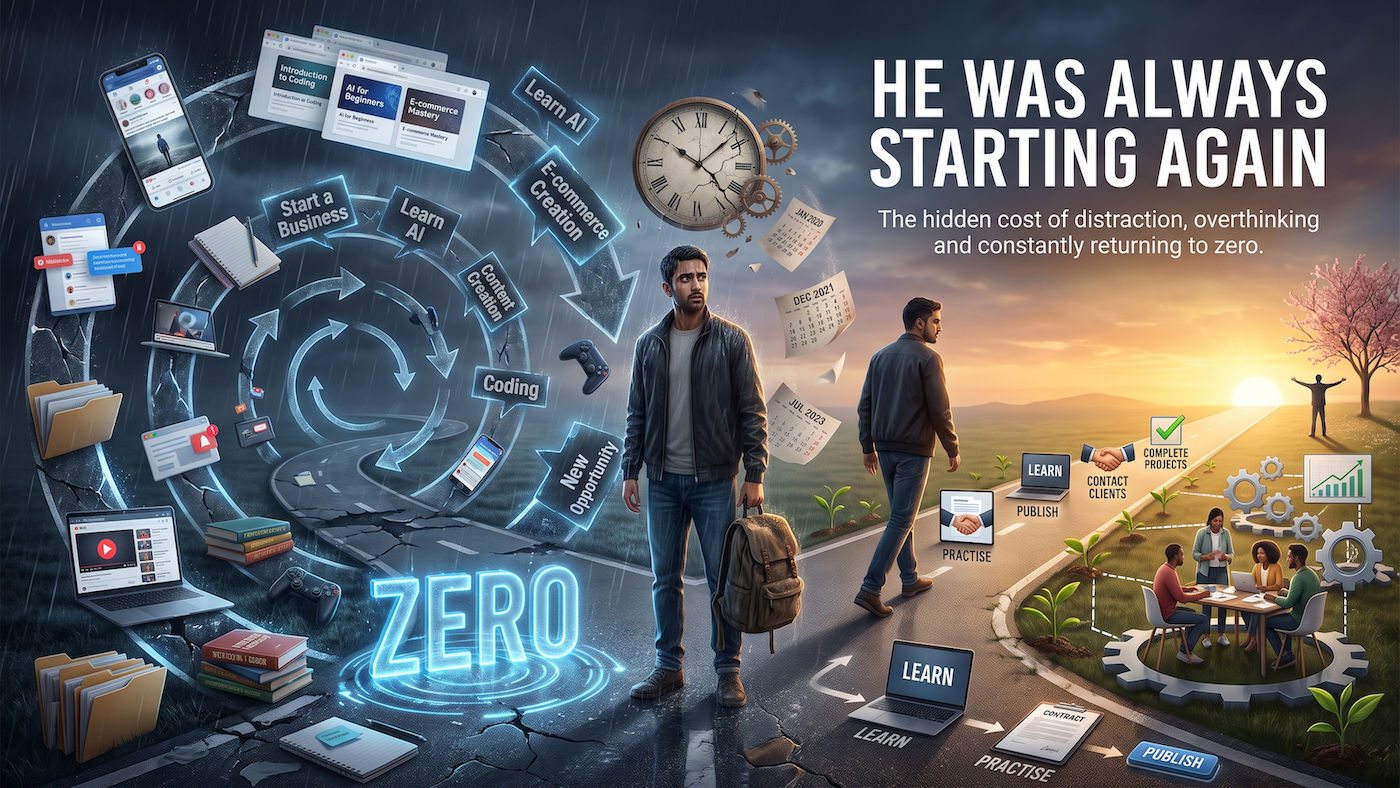
He Was Always Starting Again
He had ambition, ideas and access to more information than any previous generation. Yet every year, he found himself standing in exactly the same place.
Approximately 12–15 minutes to read
There was nothing obviously wrong with Adam’s life.
He had a place to live, food in the kitchen, a phone in his hand and enough ideas to fill ten notebooks.
From the outside, he looked normal.
He went to work. He paid his bills. He laughed with friends. He watched videos about success, business, self-improvement and financial freedom. He regularly spoke about what he planned to do next.
One month, he wanted to start an online business.
The next, he wanted to learn coding.
Then it was content creation.
Then property.
Then artificial intelligence.
Then e-commerce.
Then something else entirely.
Adam was not lazy. At least, that was what he told himself.
He was always researching.
Always planning.
Always preparing.
But somehow, he was never progressing.
Every new idea gave him a temporary feeling of excitement. For a few days, he felt like a different person. He imagined the future clearly: more money, more freedom, more confidence and a life built on his own terms.
He would create a new folder on his laptop.
He would download a few courses.
He would follow successful people online.
He would write an ambitious plan.
And then, slowly and quietly, the excitement would disappear.
The folder would remain unfinished.
The course would sit at 12 per cent complete.
The plan would be forgotten.
Adam would return to the same life he had promised himself he was going to escape.
You were not failing because you started from zero. You were failing because you kept returning to zero.
A Life Filled With Noise
Adam’s mornings usually began with good intentions.
His alarm rang at 6:30 a.m., but he rarely got up immediately. He reached for his phone to check the time, then opened social media without thinking.
One video became five.
Five became twenty.
Before he realised it, forty minutes had disappeared.
He would rush to get ready, already feeling behind.
During the day, he thought about changing his life.
At work, he imagined building something of his own.
On his lunch break, he watched videos with titles such as:
- How I Made £10,000 in 30 Days
- The Best Business to Start This Year
- Five Skills That Will Make You Rich
- Why You Must Quit Your Job Now
Each video made him feel inspired, but each one also pulled him in a different direction.
By the evening, Adam had collected twenty new ideas and completed none of the old ones.
He came home tired, ate dinner and promised himself that he would work on his future after resting for a few minutes.
A few minutes became an hour.
An hour became an entire evening.
Sometimes he watched a film. Sometimes he played games. Sometimes he scrolled through the lives of people who seemed to be moving faster than him.
He saw former classmates announcing promotions.
He saw creators celebrating milestones.
He saw business owners sharing revenue figures.
He saw people younger than him launching products, travelling, buying homes and building careers.
Adam told himself that social media only showed the highlights.
But that did not stop the comparison.
Every success story made him question his own life.
“What am I doing wrong?” he whispered one night.
The answer was uncomfortable.
He was not doing one thing wrong.
He was doing too many things halfway.
The Addiction to New Beginnings
Adam loved starting.
Starting felt clean. Starting contained no mistakes, disappointing results or evidence of failure.
A fresh idea allowed him to imagine himself as disciplined, successful and unstoppable.
Finishing was different.
Finishing required patience.
It required him to continue when the work became repetitive or boring.
It required him to face the possibility that his first attempt might not be very good.
So whenever progress became slow, Adam searched for a new beginning.
When his first videos received little attention, he decided content creation was too competitive.
When coding became difficult, he convinced himself that technology was changing too quickly.
When his online shop received no sales in the first two weeks, he decided the market was saturated.
When a potential client ignored his message, he assumed freelancing did not work.
He rarely gave an idea enough time to produce meaningful evidence.
He planted seeds, dug them up after a week and complained that nothing was growing.
Distraction does not always look like laziness. Sometimes it looks like planning ten different futures and building none of them.
Adam’s laptop became a museum of abandoned ambitions.
There were business plans, unfinished designs, unused website domains, half-written articles, spreadsheets, logos, course notes and abandoned project files.
Every folder represented a version of himself that had existed for a few days.
He called it exploration.
Deep down, he knew it was avoidance.
As long as he kept changing direction, he never had to discover whether he was truly capable of succeeding.
He could protect his confidence by saying: “I would have succeeded if I had continued.”
But he never continued long enough to find out.
The Years That Quietly Disappeared
At first, Adam believed he had plenty of time.
He was young.
There would always be another Monday, another month and another January.
But time did not leave dramatically.
It disappeared in ordinary evenings.
It disappeared in episodes watched automatically.
It disappeared in unnecessary scrolling.
It disappeared in plans that felt productive but created nothing.
One year passed.
Then another.
His situation did not become terrible, but it did not become meaningfully better either.
That was what frightened him most.
His life was comfortable enough to tolerate but frustrating enough to resent.
He was surviving, not building.
His income increased slightly, but his expenses increased too.
His responsibilities grew.
His energy became less predictable.
The freedom he thought he would have “one day” seemed to move further away.
At a friend’s birthday dinner, Adam sat across from Daniel, someone he had known since school.
Daniel had spent the past four years building a small marketing agency.
It had not made him famous.
He did not drive an expensive car or post motivational speeches online.
But he now worked with several regular clients, employed two people and had control over most of his schedule.
Adam: “I still remember when you started. You barely knew anything about marketing.”
Daniel: “I still feel like I barely know anything.”
Adam: “But you built all of this.”
Daniel: “I just stayed with it.”
The sentence sounded too simple.
Adam expected a secret strategy, a special connection or a life-changing opportunity.
Daniel: “The first year was horrible. I earned almost nothing. I sent hundreds of messages. Most people ignored me. My work was average, but I kept improving it.”
Adam: “How did you know it would work?”
Daniel: “I didn’t.”
That answer remained with Adam.
Adam: “How did you keep going without knowing?”
Daniel thought for a moment before answering.
Daniel: “I stopped asking whether it was working every week. I asked whether I was getting better.”
Adam looked down at the table.
For years, he had measured every path by how quickly it rewarded him.
Daniel had measured his path by how consistently he improved.
The Painful Realisation
That night, Adam opened his laptop.
He looked through his old folders.
Some had not been opened in years.
He found a document titled “My Five-Year Plan”.
He checked the date.
It had been written four years earlier.
The goals inside were painfully familiar:
- Build a valuable skill.
- Start a business.
- Create multiple income streams.
- Improve his health.
- Read more.
- Waste less time.
- Become financially independent.
Adam stared at the screen.
He had written similar goals every year.
The words had changed slightly, but his life had not.
For the first time, he did not blame his job, the economy, his upbringing, the algorithm, a lack of money or bad timing.
Those challenges were real, but they were not the full explanation.
His biggest problem was not a lack of talent.
It was not a lack of information.
It was not even a lack of opportunity.
It was a lack of commitment.
He wanted certainty before action.
He wanted motivation before discipline.
He wanted results before repetition.
He wanted to scale something before proving he could stay with it.
Adam closed every browser tab.
For once, he did not search for another video.
He took out a notebook and wrote one question:
What could my life look like in three years if I stopped changing direction?
He sat with the question for a long time.
Then he wrote another:
What will my life look like in three years if I continue like this?
The second answer frightened him more than failure ever had.
Choosing One Path
The next morning, Adam did not transform into a different person.
He still felt uncertain.
He still had doubts.
He still wanted to explore several ideas.
But he made one decision.
For the next 12 months, he would focus on building one valuable skill and turning it into a reliable service.
He chose digital marketing.
Not because it was guaranteed to make him rich.
Not because it was the newest trend.
He chose it because businesses needed customers, he enjoyed communication and creativity, and he could start using the laptop he already owned.
His old pattern immediately returned.
- What about artificial intelligence?
- What about e-commerce?
- What about building an app?
- What if there is a better opportunity?
This time, Adam answered differently.
There will always be another opportunity. I need to become the kind of person who can finish one.
He created a simple rule.
He was allowed to write down new ideas, but he was not allowed to pursue them during his 12-month commitment.
The ideas went into a document called “Not Now”.
That title changed something.
He was not saying no forever.
He was saying no for long enough to give one path a genuine chance.
Rebuilding From Zero
Adam’s new beginning was not cinematic.
There was no dramatic music.
No investor appeared.
No viral post changed his life.
His first step was spending one hour each evening learning one specific part of digital marketing.
He studied how businesses attracted customers.
He learned basic copywriting.
He practised writing advertisements.
He analysed websites.
He created sample campaigns for imaginary clients.
At first, his work was poor.
He wrote headlines that sounded unnatural.
His designs looked amateur.
His strategies were too general.
He wanted to quit several times.
But instead of searching for another path, he asked a better question:
What is the next skill I need to improve?
After three months, Adam created a small portfolio.
It was not impressive, but it existed.
That mattered.
For years, his ideas had lived inside his head. Now he had something visible.
He began contacting local businesses.
His first messages received no replies.
His next messages received polite rejections.
One business owner replied: “Thanks, but we already handle this internally.”
Another wrote: “Not interested.”
Adam felt embarrassed.
For a few hours, he considered giving up.
Then he remembered Daniel’s words.
He stopped asking whether the strategy had worked.
He asked whether he was getting better.
He reviewed his messages and realised they were focused entirely on himself.
- I am learning marketing.
- I offer social media services.
- I can create content.
The businesses did not care about his ambition.
They cared about their problems.
So Adam changed his approach.
He researched each business, identified one opportunity and sent a short, personalised suggestion.
His reply rate improved.
Eventually, a local café agreed to let him create a small promotional campaign.
The owner could only pay £150.
It was not life-changing money.
But to Adam, it was evidence.
For the first time, someone had paid him for a skill he had deliberately built.
He completed the work carefully.
The campaign brought new customers to the café.
The owner recommended him to another business.
That business paid £300.
Then came a monthly client.
Then another.
Progress remained slow.
Some clients left.
Some campaigns failed.
Adam made mistakes with pricing, communication and time management.
There were weeks when he felt exhausted.
There were months when his income barely changed.
But he no longer returned to zero.
Every mistake became part of the same path.
Every project added experience.
Every conversation improved his confidence.
Every result strengthened his portfolio.
Movement Is Not Always Progress
Before Adam changed, he had always been busy.
He watched tutorials.
He created plans.
He discussed ideas.
He reorganised folders.
He researched tools.
He consumed information.
But none of those activities consistently produced something valuable.
He had mistaken movement for progress.
Movement feels active.
Progress creates evidence.
- A person can spend six hours researching fitness and never exercise.
- They can watch business videos every evening and never make an offer.
- They can redesign their logo ten times and never speak to a customer.
- They can plan a book for years and never publish a page.
The life you want will not be created by the ideas you collect, but by the actions you repeat.
Adam began measuring his days differently.
Instead of asking, “Was I motivated today?”, he asked, “What did I produce?”
Instead of counting how many videos he watched, he counted how many campaigns he created.
Instead of celebrating a new idea, he celebrated a finished task.
Instead of constantly redesigning his plan, he followed it long enough to gather meaningful results.
This did not make life easy.
It made life clearer.
The Thing That Finally Scaled
Three years after the conversation with Daniel, Adam’s life looked different.
Not perfect.
Different.
His marketing service had grown into a small agency specialising in helping independent hospitality businesses attract local customers.
He had developed repeatable processes.
New clients completed the same onboarding system.
Campaigns followed proven templates.
Reports were generated through organised tools.
Freelancers helped with design and content.
Adam no longer personally completed every small task.
The business could serve more clients without requiring him to work every hour of the day.
He had finally created something that could scale.
But the business was not his greatest achievement.
His greatest achievement was becoming someone who could stay with a problem.
He was no longer addicted to new beginnings.
He trusted repetition.
He respected time.
He understood that success was not built through one perfect decision.
It was built through hundreds of ordinary decisions made in the same direction.
One evening, Adam opened the old “Not Now” document.
It contained dozens of ideas.
Some were no longer relevant.
Some looked ridiculous.
A few were genuinely promising.
But now he understood something he had not understood before.
Ideas were not rare. The ability to execute was rare.
He could now choose a new project without using it as an escape from the old one.
He had built the discipline required to turn opportunity into something real.
Five Steps to Stop Returning to Zero
Adam’s story is not really about digital marketing.
It is about direction.
Your path may involve a career, a business, a creative skill, education, health or a personal project.
The specific path matters less than your willingness to walk it long enough.
1. Choose One Clear Direction
You do not need to choose what you will do for the rest of your life.
Choose what you will focus on for the next six to twelve months.
Your direction should be specific enough to guide your daily actions.
- Instead of “become successful”, choose “learn video editing and secure three monthly clients”.
- Instead of “build an online business”, choose “create and sell a digital product for new business owners”.
A clear direction helps you decide what deserves your attention and what must wait.
2. Remove or Control Major Distractions
You do not need to disappear from the world, but you must protect your attention.
- Turn off unnecessary notifications.
- Remove distracting apps from your home screen.
- Set boundaries around entertainment.
- Create a dedicated time and place for focused work.
- Keep a “Not Now” list for ideas that could pull you away from your current goal.
Your attention is one of your most valuable resources. Spend it deliberately.
3. Create a Simple 90-Day Plan
Do not build a complicated five-year strategy before completing your first week.
Choose one meaningful outcome for the next 90 days.
Break it into monthly milestones.
Then decide what must happen each week.
Your plan should be simple enough to follow when you are tired, uncertain or unmotivated.
A basic plan followed consistently will outperform a perfect plan that is constantly changed.
Download the free 90-day focus guide to create your plan.
4. Focus on Daily Output, Not Instant Results
You cannot fully control sales, views, promotions, followers or opportunities.
You can control your output.
- Write the page.
- Send the proposal.
- Complete the lesson.
- Publish the video.
- Make the call.
- Practise the skill.
Results often arrive later than effort.
Do not stop planting because nothing appeared after seven days.
5. Review Progress Without Changing Direction
Review your work regularly, but do not use every disappointing result as an excuse to quit.
Ask yourself:
- What improved?
- What failed?
- What did I learn?
- What should I adjust?
- What should remain the same?
Change your method when necessary.
Do not automatically abandon the mission.
There is a difference between adapting and escaping. Learn to recognise it.
Your Next Step
Perhaps you recognise yourself in Adam.
Perhaps you have folders filled with unfinished projects.
Perhaps you have watched other people progress while telling yourself that your moment is coming.
Perhaps you are waiting to feel ready.
You may never feel completely ready.
The path may not become perfectly clear before you begin.
You do not need another year of inspiration.
You do not need twenty more ideas.
You do not need permission.
Choose one path.
Decide what the next 90 days will be about.
Then take one action today that leaves evidence behind.
Not another saved video.
Not another motivational quote.
Not another plan that disappears by next week.
Create something.
Send something.
Finish something.
Your future will not be built in one dramatic moment.
It will be built quietly through the actions you are willing to repeat after the excitement has gone.
Start from zero if you must. Just stop returning there.
Related service: if this is a live challenge for your business, this connects directly to how I can help.